

Note 26 · Growth stories
Celebs: less waiting, more reasons to try again

A little less waiting. Another little try.
Measure the gap between a result being ready and becoming usable. Test one shorter reveal with a stable cohort, then follow useful repeat actions and costs. Faster output alone does not prove better retention or profitable growth.
Would the seventh reveal still be fun?
A dramatic loading sequence can feel like part of the show. Repeat it for every result and it becomes a product decision: how much waiting are you asking someone to enjoy?
In a RevenueCat interview published on 19 October 2026, Celebs’ team describes removing elaborate generation animations and reducing generation time from five seconds to 1.4. They also report letting people reach a first generation before the paywall.
This is a retrospective, not a newly shipped October feature. Test dates, sample sizes and device or country splits for those changes are not supplied. The account suggests a hypothesis; it does not isolate the retention effect of faster results.
A result someone can react to.
Celebs, by Sociaaal LLC, is an iPhone celebrity-lookalike app. Its US listing describes comparing a photo with celebrity images and sharing the result. That makes the reveal itself a useful place to examine friction.
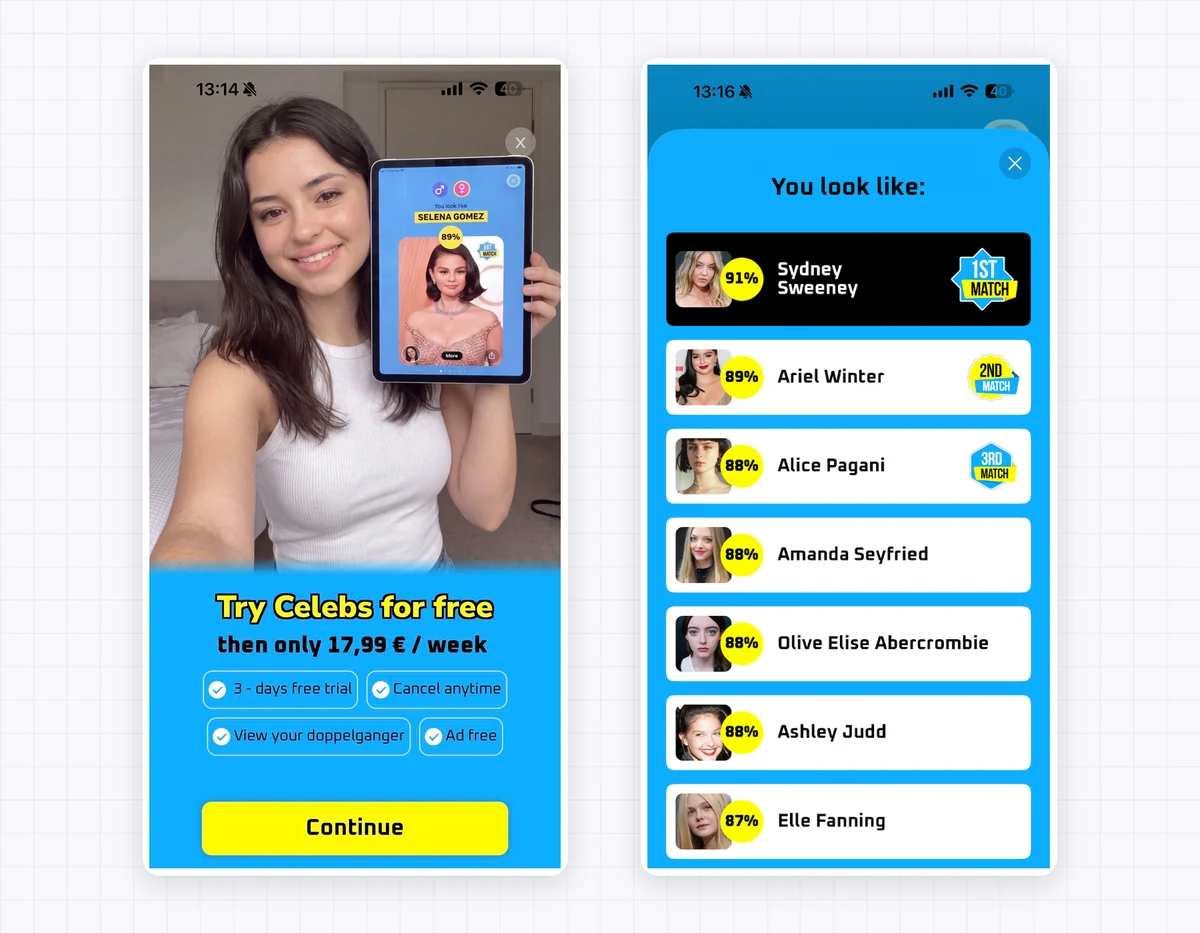
The offer and the result, as shown in the interview.
 Open full image
Notice the specific result beside the offer. This composite does not establish screen order or time to result; displayed match scores are product UI, not measured accuracy.
Find the part of the wait you control.
For a small iOS team, our proposed starting point is a trace of one repeated task. Separate the moment someone requests a result, the moment processing finishes, and the moment that result is usable on screen. A decorative sequence can continue after the work is already done.
Record those intervals on supported iPhones, including slower devices and network conditions when processing is remote. Keep errors and cancellations visible in the analysis: looking only at completed requests hides people who gave up.
Then choose one change. If the delay comes from a fixed animation, remove that delay while keeping progress feedback and a way to cancel. If processing dominates, investigate that separately. Changing the model, onboarding and paywall together would make it hard to learn which change mattered.
Try this with one repeated job.
Hypothetical experiment, not Celebs data: an iPhone app turns a rough sketch into a sticker. Keep the same model, generation allowance, price and acquisition mix. Randomly assign eligible first-time users to the existing reveal or a version that shows the sticker as soon as it is ready. Keep assignments stable.
- Immediate result: measure usable-result time alongside the fraction of all assigned users who complete a generation within 24 hours.
- Another useful attempt: count users who save a second, distinct sticker within seven days of assignment. Divide by all assigned users, including those who never finish the first.
- Return: separately count users who save a sticker on a later calendar day within that same window. Repeated tapping in one session is a different behavior.
Define the timezone, eligibility, minimum sample and analysis date before enrolling anyone. Wait until both groups have the full window. Check the uncertainty around the difference; a small, noisy change is a reason to keep learning, not to declare a winner.
More attempts still have to earn their cost.
For the sticker example, follow net purchase proceeds and variable generation costs per assigned user over days 0–30, inclusive. A faster reveal might encourage useful exploration, or just more paid compute. Keep failures, refunds and support complaints beside the revenue result.
If repeat saving improves without a damaging cost or quality trade-off, the team has a reason to keep the shorter reveal. If only generation count rises, investigate whether anyone actually wants the extra outputs before increasing the free allowance.
Use the event-planning note to define completion and the LTV guide to keep cohort economics consistent. The next experiment should answer a specific question about the experience people repeat.
Sources & further reading
- RevenueCat — original interview with Sociaaal, published 19 October 2026; historical experiments, exact dates unspecified
- Celebs — official US iPhone App Store listing, accessed 20 October 2026
Company results are attributed to the sources above. Examples are hypothetical experiments proposed by Piiko, not industry benchmarks. This is independent analysis; app icons identify their respective owners. Cover illustrations are original Piiko editorial art.