

Note 34 · Growth stories
Clash of Clans: faster upgrades, the same collection clock

A little help with the next step.
Check the whole progression loop before adding a boost: resource costs, waiting time, production and capacity. Test one useful milestone and follow ordinary play after expiry. Faster event progress alone does not establish retention or better economics.
A new destination needs a reachable next step.
A player can want the next upgrade and still leave it unfinished. Perhaps the resource bill is too large. Perhaps the builder is occupied. A better destination does little for someone stuck on the way there.
Supercell’s 1 November 2026 season announcement places Hammer Jam alongside an upcoming Town Hall 19 release, scheduled for mid-month. The promotion changes the journey: cheaper upgrades, shorter waits and more resources to put to work.
The detailed event guide gives the exact window: 1 November at 08:00 UTC through 16 November at 08:00 UTC. Town Hall 3 and above can participate. Eligible Home Village upgrades using Gold, Elixir or Dark Elixir cost half as much and take half as long; the Forge also receives those reductions. Supercharges and Crafted Defenses are excluded, as are Builder Base and Clan Capital.
Our interpretation: this is useful material for a comeback experiment because it changes what a returning player can finish. This note, reviewed on 2 November, analyzes the announced design. The sources provide no event retention or revenue results, and no iOS-specific performance breakdown. The game’s official iPhone and iPad listing establishes the iOS context.
Sell the work a player can finally finish.
Builders arrive. The upgrade becomes the story.
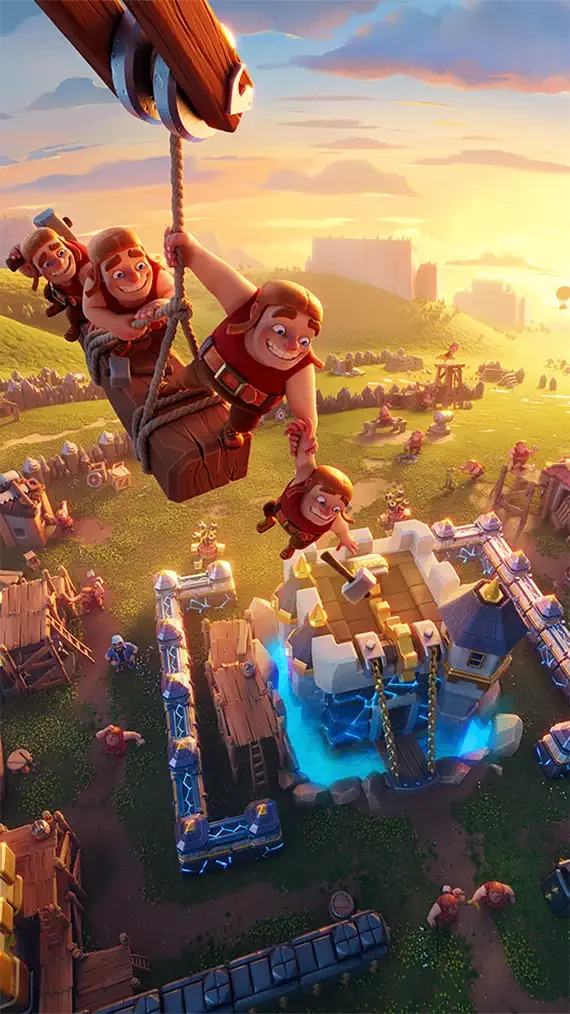
Look at the subject. The artwork puts construction and extra hands at the center. Our visual reading: it makes help with unfinished work tangible.
Read the offer beside it. The App Store event description promises halved Home Village upgrade times and costs, plus doubled collector production and capacity. These benefits come from the listing text; the artwork does not display the numbers.
Keep the evidence separate. This is promotional artwork, not an in-game screen or proof that the campaign increased returns.
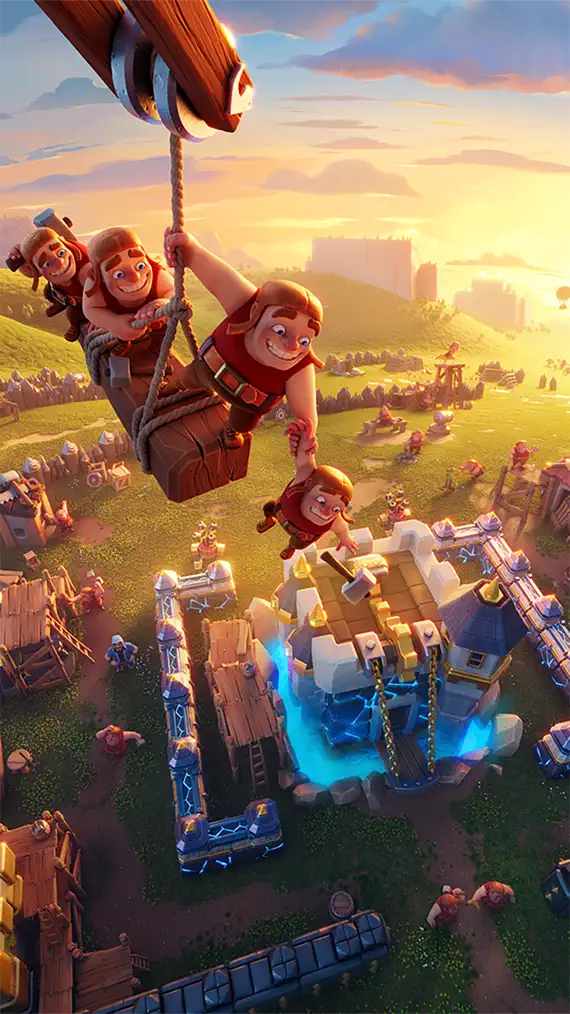
For a smaller iOS game, that suggests a concrete message to test: show the next meaningful thing a player can complete. A generic bonus badge leaves the player to translate the reward into a reason to return.
Double the output. Keep the collection clock.
Hammer Jam doubles both collector production and capacity. A full collector still stops producing. There is a useful distinction here: a larger capacity does not automatically mean a longer interval before collection becomes necessary.
More resources in the same ten hours.
Usual collector
- Capacity
- 1,000 units
- Production
- 100 units/hour
1,000 ÷ 100 = 10 hours
Time from empty to full
Both doubled
- Capacity
- 2,000 units
- Production
- 200 units/hour
2,000 ÷ 200 = 10 hours
Time from empty to full
That is arithmetic, not a claim about Supercell’s intent. It shows why a designer should check both the production rate and the storage limit before saying a boost makes the game less demanding. Faster upgrades can also change when a player has something new to start.
The useful result arrives after the boost ends.
Hypothetical iOS pilot: a small village-building game offers returning players a three-day reduction on one early building’s resource cost and timer. Choose the building because interviews and event logs identify it as an obstacle to the next enjoyable activity. Keep the offer modest and explain its expiry before a player starts.
Randomly assign eligible returning accounts to the offer or normal progression at their first return, keeping acquisition messages identical. Define eligibility in advance—for example, no session for 14 days and that building still unfinished. This tests what happens after a return; it does not establish that the offer caused more people to come back. For a shared economy, first check whether players can transfer the benefit into the comparison group.
Use a few useful events: offer assignment, upgrade completion and an ordinary meaningful action after expiry. Compare the share completing that ordinary action during the seven days immediately after their assigned offer window, using all assigned accounts in each group as the denominator. Give the comparison group the same observation window and wait for it to close.
Also compare purchase proceeds after refunds and store fees, ad receipts and variable service costs per assigned account over a predeclared 30-day window. Faster progression might replace spending or pull tomorrow’s play into today. Treat this as a pilot readout, not lifetime value, and report uncertainty if the audience is small.
Decide whether the milestone opens an activity people continue to enjoy at normal pace. If the only improvement disappears with the discount, revisit the bottleneck before scheduling a larger event.
Sources & further reading
- Supercell — Hammer Jam detailed guide, 1 November 2026
- Supercell — November season announcement, 1 November 2026
- Supercell — Hammer Jam US App Store event, accessed 2 November 2026
- Clash of Clans — official US iOS App Store listing
Company results are attributed to the sources above. Examples are hypothetical experiments proposed by Piiko, not industry benchmarks. This is independent analysis; app icons identify their respective owners. Cover illustrations are original Piiko editorial art.