

Note 33 · iOS monetization
RevenueCat puts rewarded premium access on a timer
A useful door, open for a little while.

Test a bounded useful session, distinguish access from payment, and compare ad receipts plus purchase proceeds after variable costs across all assigned users. A larger premium audience alone does not establish better economics.
What if the reward was time with your best feature?
Someone wants to use a premium tool for one task, but will not subscribe today. An optional ad could pay for that session. The interesting question is whether it creates value that would otherwise disappear, or replaces a purchase you would have earned.
In its 29 October 2026 App Growth Annual recap, RevenueCat describes Rewarded Ads as a public beta. Its AdMob integration can grant currency or temporary access to paid features after verifying the reward. The recap covers announcements from the previous week; this is not a claim that rewarded advertising itself is new.
For a small iOS team already using RevenueCat and AdMob, that makes a bounded access experiment worth considering. The announcement establishes a capability, not evidence that ads improve subscription economics.
Choose the feature and the clock together.
The reward guide requires iOS 15+, purchases-ios 5.89.0+, an AdMob adapter and a linked account. Entitlements last at least 30 minutes. Server-verified ad completion grants access.
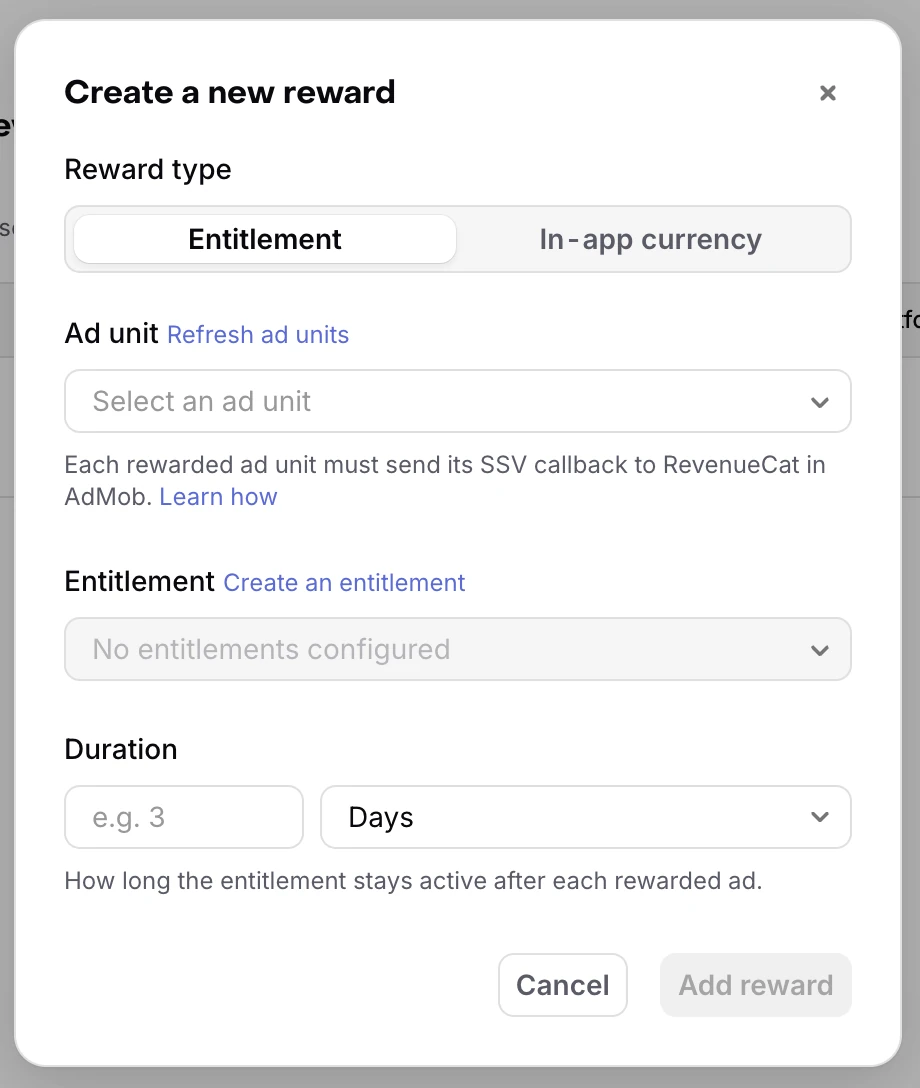
One reward has both an entitlement and a duration.
 Open full image
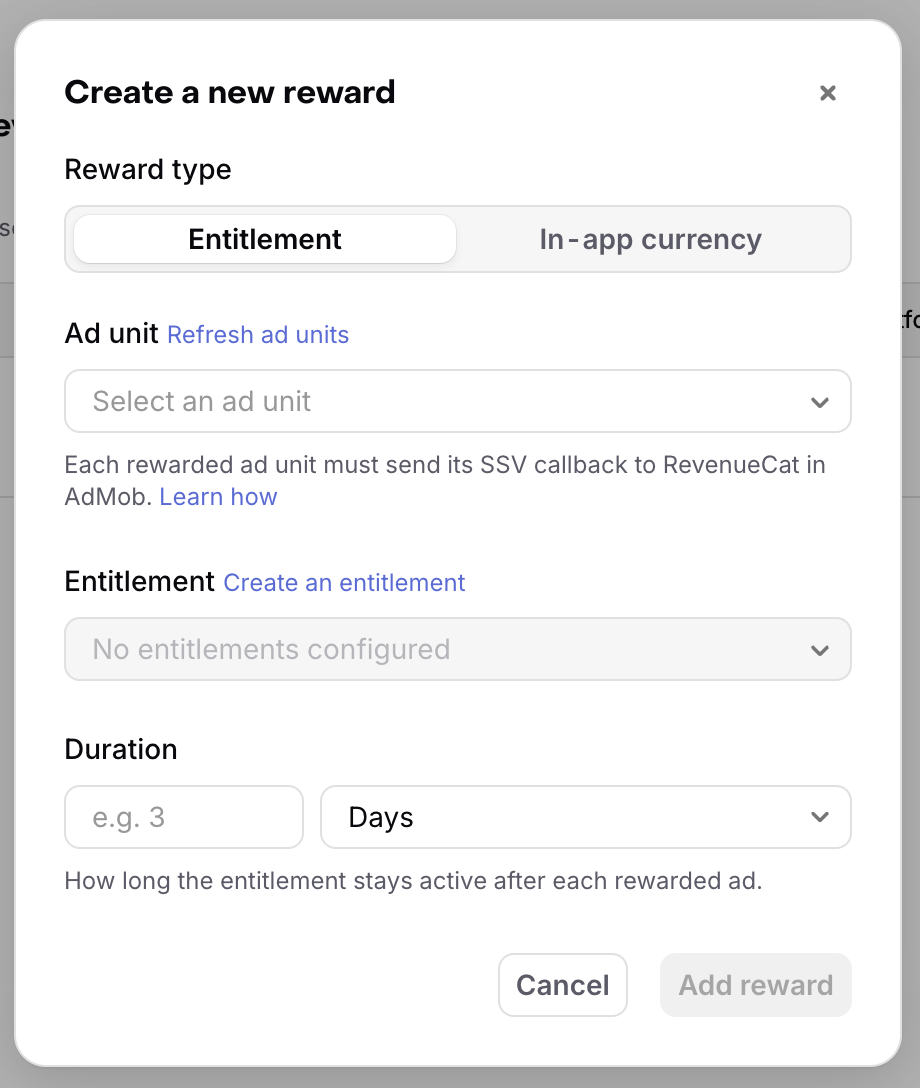
The empty fields are useful: access and duration are decisions the team must make. The displayed Days selector is not a recommended reward length.
Our product suggestion: choose a task whose benefit fits inside the window. Thirty minutes of a locally rendered brush set is a different promise from thirty minutes of unlimited cloud generation. Price the actual work the user can do, including its variable cost, before choosing the reward.
Premium access does not mean a new subscriber.
Ad-earned access has an expiry. RevenueCat does not notify the app at expiration; check current access at feature gates.
That creates a measurement trap. If your own analytics calls every newly active premium user a subscriber, this experiment will inflate that count without a purchase. Record the grant’s origin separately. Count confirmed paid StoreKit transactions for purchase outcomes, and keep trials, ad rewards and payments distinguishable in your event plan.
Before enrolling users, exercise the whole promise: no ad available, interrupted viewing, delayed verification, relaunch, expiry while the tool is open, and a purchase during temporary access. Keep existing paid access intact. Decide how someone finishes or saves work when the timer ends.
Try one borrowed session.
Hypothetical iPhone pilot: a drawing app offers a bonus brush set to returning free users who saved two sketches in the previous week. Use one storefront and supported builds; exclude anyone with paid or trial access. Randomly assign eligible users to the usual purchase path or that same path plus an optional ad for 30 minutes of the brush set.
Keep the subscription price, free tools and purchase option unchanged. State the feature and duration before the ad, and show the remaining access afterward. Limit the pilot to one reward per user per day, implemented and verified by the app team. This is a proposed experiment, not a built-in RevenueCat targeting rule.
Record the offer, acceptance, verified grant and a sketch saved with the brushes. Those are four different events. RevenueCat’s ad-tracking guide says offer impressions and acceptances need manual tracking, even with its adapter. A missing offer event would hide the people who decline.
Count what the ad adds—and what it replaces.
Choose an enrollment period and follow every assigned user for the same 30 days. Compare (net purchase proceeds + net ad revenue − attributable variable costs) ÷ all assigned users. Include people who never watch an ad. Our LTV guide explains the proceeds and cost basis; this is a fixed-window experiment measure, not lifetime profit.
An ad revenue increase can coexist with fewer subscriptions. Read both components, completed sketches, repeat drawing, refunds and support demand. Keep experiment setup costs separate, then include them when judging whether the work was worthwhile. Small samples and delayed purchases can leave the result inconclusive.
RevenueCat distinguishes live SDK revenue reporting from the ad network’s final reconciliation. Reconcile the receipts before deciding to expand. The useful outcome is a session that earns its cost and leaves users wanting to draw again—not simply a larger number of people marked premium.
Sources & further reading
- RevenueCat — App Growth Annual recap, published 29 October 2026; announcements from the preceding week
- RevenueCat — Granting Ad Rewards: beta, iOS prerequisites, temporary entitlements and expiry; accessed 30 October 2026
- RevenueCat — Ad Monetization: prompt tracking and revenue reconciliation; accessed 30 October 2026
Examples are hypothetical unless explicitly attributed to a real product. Hypothetical examples illustrate the method and do not represent Piiko results or industry benchmarks.