

Note 21 · Growth stories
Roblox turned its birthday into a discovery quest

A little route to something new.
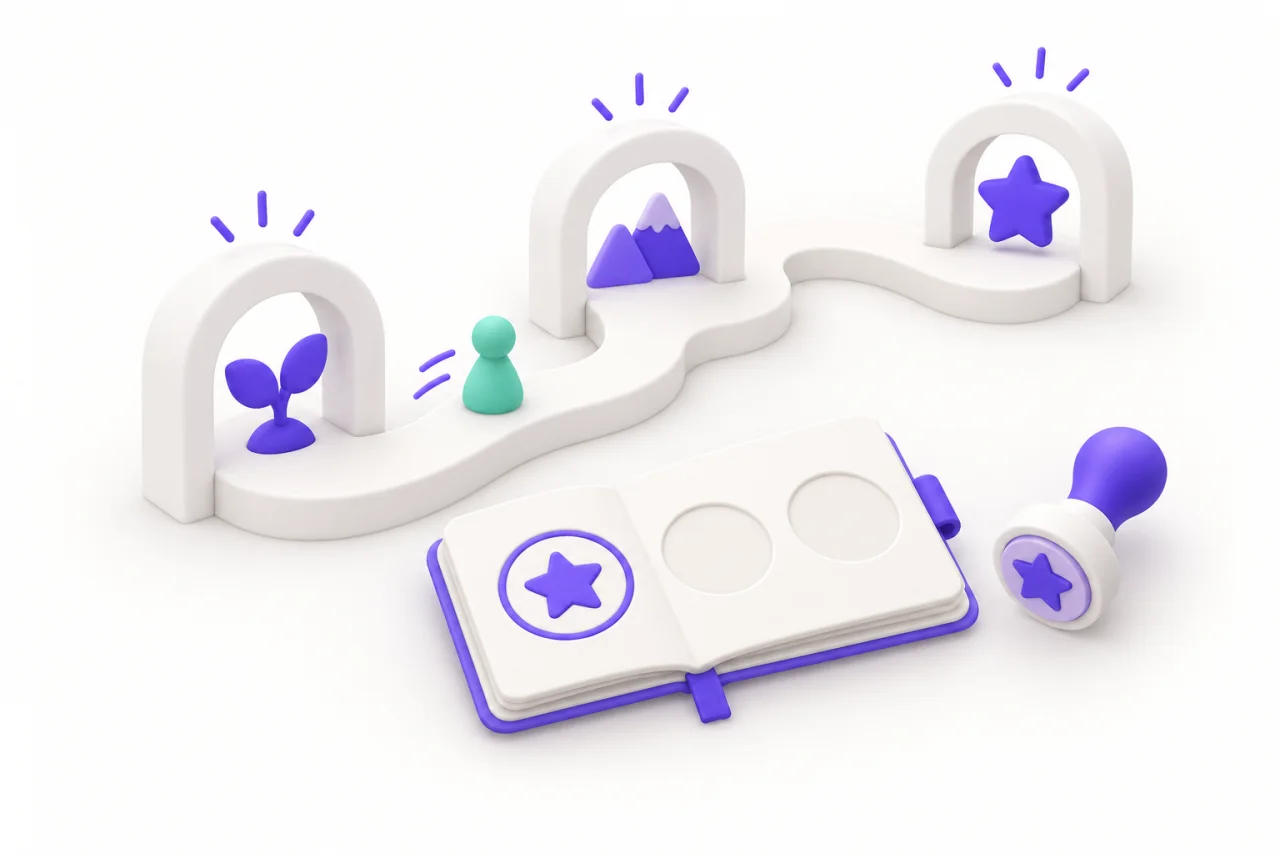
Give players a useful route through existing content, then measure whether they return after the reward ends. A monthly revenue chart cannot prove that a quest caused growth.
A birthday you could play.
Roblox made its anniversary into a journey through its catalogue. Its 16 September 2026 announcement described The Hunt: Roblox 20, running from 17 to 28 September. Players entered a hub, completed quests through 20 years of games, collected virtual rewards, and unlocked 20 more games after finishing the historical route.
The event also linked a temporary benefit to a subscription: everyone could try a Classic app theme, while active Roblox Plus subscribers could retain it after the event. These were platform-wide mechanics, not an iPhone-only campaign; Roblox is available on iOS.
Our reading of the design: the next game became a step in a journey. A big catalogue gained a small, understandable next action. For an iOS team with several modes, lesson types or creative tools, that is a useful discovery idea to test.
The chart is not the experiment.
SocialPeta’s report published 10 October 2026 estimates that Roblox’s global mobile store revenue rose 88.2% in September compared with August. Its estimates combine the App Store and Google Play where available. This is a modeled monthly change for the title, not audited company revenue, an iOS result or a retention benchmark.
The event overlapped that month, but the report cannot isolate its contribution. We cannot conclude that quests caused the increase, or separate the effect of rewards, subscription benefits and other September activity. The report prompted this retrospective; the event itself ended in September.
Use the chart to find a product worth examining. Use your own experiment to decide whether the mechanism belongs in your app.
Give existing content a small discovery passport.
Hypothetical example: an iPhone puzzle game has three modes, but returning players mostly use the first. Instead of producing another mode, offer an optional passport with one short challenge in each existing mode. Completing the route earns a cosmetic stamp; the familiar way to play stays available.
Each stop needs a satisfying action, not just a screen visit. Let players finish a manageable puzzle, see their progress and understand the next invitation. Keep the route resumable so an interrupted session does not erase the work.
A subscription app could explore the same question with useful capabilities: create a sketch, try a texture, export something worth keeping. The product should earn the second visit through the activity itself. A countdown or locked reward cannot tell you whether someone found lasting value.
Start with content you already maintain. Write down the intended discovery, the completion event and the extra support or production work before building. Our small event plan can help distinguish opening a mode from successfully using it.
Who comes back without the stamp?
Hypothetical test: enrol US iPhone players who completed a puzzle in the previous seven days but have never completed either secondary mode. Randomly assign them to the optional passport or the existing experience, keeping assignment stable. This evaluates discovery among existing players; it says nothing about new-install acquisition.
- Make the reward window explicit. Offer the passport during days 0–6 after assignment. Everyone keeps ordinary access to all three modes; no passport reward is available from day 7 onward.
- Measure beyond collection. The primary outcome is the share of all assigned players completing a puzzle in a secondary mode on at least two distinct days during days 7–20. Keep people who ignore the invitation in the denominator.
- Check what the route displaces. Compare total completed puzzles per assigned player, crashes and support requests over days 0–20. More secondary-mode play can simply replace the original mode, so do not call it incremental engagement by itself.
Before launch, choose the smallest improvement worth maintaining, estimate the required sample from your baseline and set a review date. If the audience is too small for a useful estimate, treat the result as an exploratory signal. Do not turn an uncertain result into a revenue promise.
A later monetization test can follow net proceeds for a fixed cohort. For this first test, the decision is narrower: did the guided route help people find something they chose to use again after the reward disappeared?
Sources & further reading
- Roblox — The Hunt: Roblox 20, announced 16 September 2026; event 17–28 September
- SocialPeta — September mobile game estimates, published 10 October 2026; combined store coverage
- Roblox — Official iOS App Store listing, reviewed 11 October 2026
Company results are attributed to the sources above. Examples are hypothetical experiments proposed by Piiko, not industry benchmarks. This is independent analysis; app icons identify their respective owners. Cover illustrations are original Piiko editorial art.