

Note 37 · Growth stories
Crossy Road Rush found its runner inside a shooter
Keep the part that’s fun to steer.
Give players the same short course with one mechanic removed. Watch what they choose to try again. Test shared play separately before investing in multiplayer.
They built a shooter. The ride was more interesting.
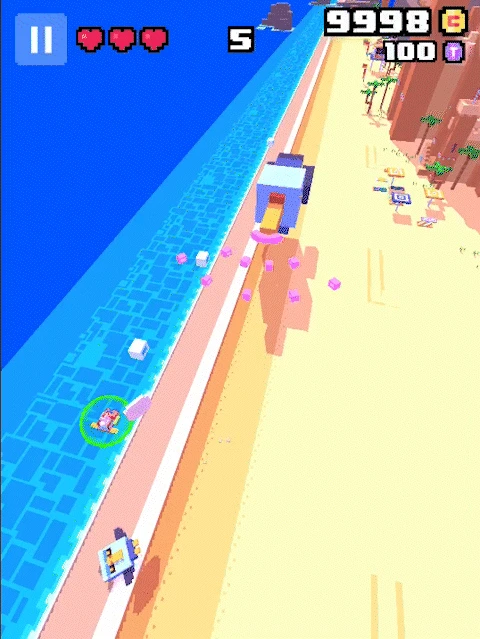
Crossy Road Rush started as a shoot-’em-up called Schmuppy. In Hipster Whale’s account of the prototype, the team singles out two things it wanted to keep: the vehicles and the freedom to steer them. The shooter became a different game.
Studio head Clara Reeves remembers a particularly telling playtest. Several people were having fun weaving through obstacles together on a barely built road. In her 5 November interview, she says that part survived even as the game’s look changed. The studio doesn’t give dates for those prototypes; 5 November 2026 is the Apple Arcade release date.
 Enlarge prototype frame ↗
The player still has to pick a line.
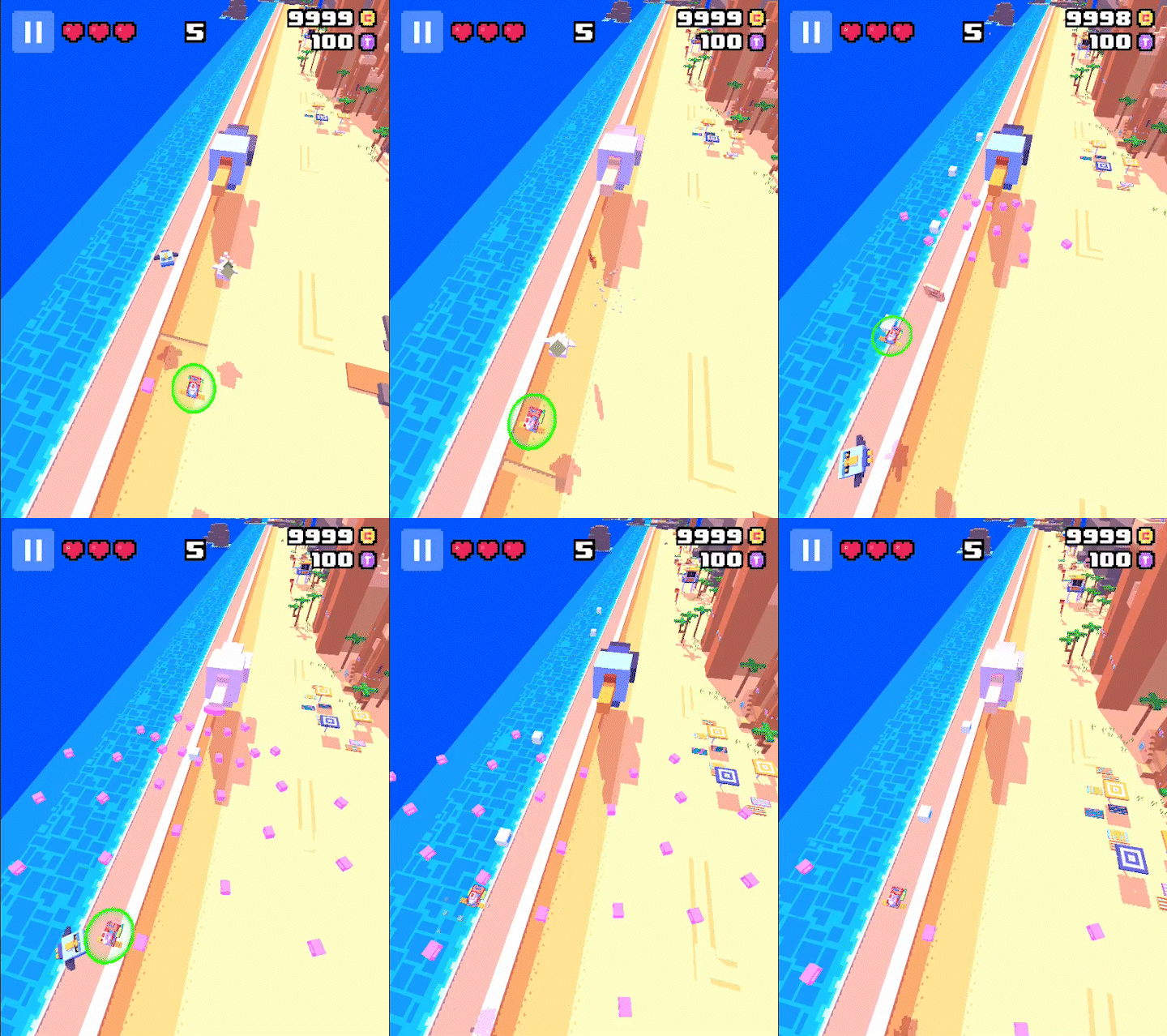
The shipped game asks the player to steer through obstacles, jump and ride along walls. Reeves describes free movement rather than automatic lane changes. Rush also supports up to four players sharing a pool of lives. These are different bets: steering has to feel good in one pair of hands; a shared life can make a friend’s mistake matter to everyone.
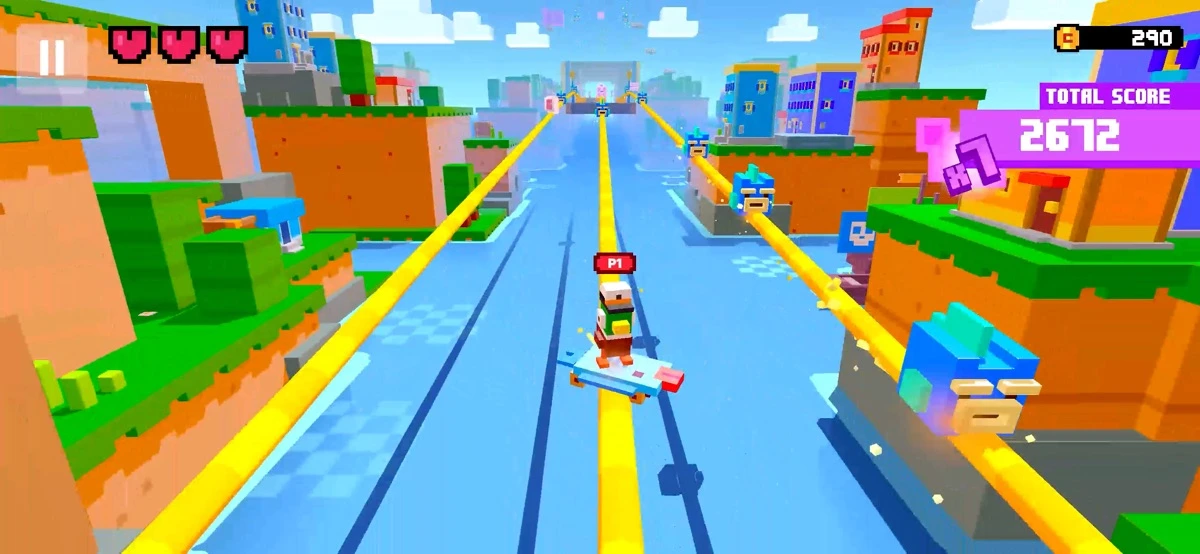 Enlarge iPhone example ↗

Hipster Whale says multiplayer affected every team. For a small studio, that detail matters more than the player count: first find out whether the move is worth repeating, then find out what a second player adds. The launch materials don’t establish how either choice affected retention or revenue.
Try the same course with one mechanic missing.
Suppose your iPhone prototype lets a rider steer and fire. Build one short course that can be finished either way. Put a switch in the test build to disable firing. Keep the obstacles, speed, touch controls and reset time identical. Let new testers play both versions, alternating which comes first.
When a run ends, leave the restart button available. If someone tries again, watch what they change: do they take a tighter line, time a turn differently, or just hunt for the missing fire button? Ask which version they’d take for one more run, and why. A replay to fix a missed turn tells you something a completion count cannot.
If steering alone gives players a move they want to master, spend the next build on another bend that uses it. If firing created the only interesting choice, keep it and improve the encounter. If the fun only appears when players react to each other, test a paired run before committing to online co-op. This is a proposed iOS playtest, not a reconstruction of Hipster Whale’s process or a retention benchmark.
For a different prototype question, Orisuji’s folding maze asks whether a move changes the next decision. Here, removing a move is what lets you see the decision that was there all along.
Sources & further reading
- Hipster Whale — launch Q&A, Schmuppy prototype and original animation
- Clara Reeves, interviewed by Pocket Gamer — 5 November 2026; early multiplayer playtest and movement design
- Hipster Whale — official press kit, release date and shared-life co-op
- Crossy Road Rush — official US App Store listing, iPhone gallery and icon; accessed 6 November 2026
Company results are attributed to the sources above. Examples are hypothetical experiments proposed by Piiko, not industry benchmarks. This is independent analysis; app icons identify their respective owners. Cover illustrations are original Piiko editorial art.