

Note 25 · iOS game design
Orisuji turns a fold into a game idea
A little fold. A new way through.
Start with an action that changes the player’s choices. Prototype one consequence, watch whether someone can predict it, then test a second challenge using the same rule. A memorable input is a starting point; it does not prove demand or retention.
Start with a move worth building around.
A game idea can start with a verb: fold, rotate, stretch, erase. The useful question is what that action changes for the player. Does it create a new decision, or only a pleasing animation?
Orisuji, by Adrien Friggeri, makes folding change a paper maze: one page covers another, connecting routes across gaps. That gives us a concrete product-design example to inspect.
At our review on 18 October 2026, its US App Store listing says “Expected Oct 23, 2026.” This is a look at the announced design before release, not a playtest or evidence of commercial success.
See the rule in the real screenshots.
One surface changes another.
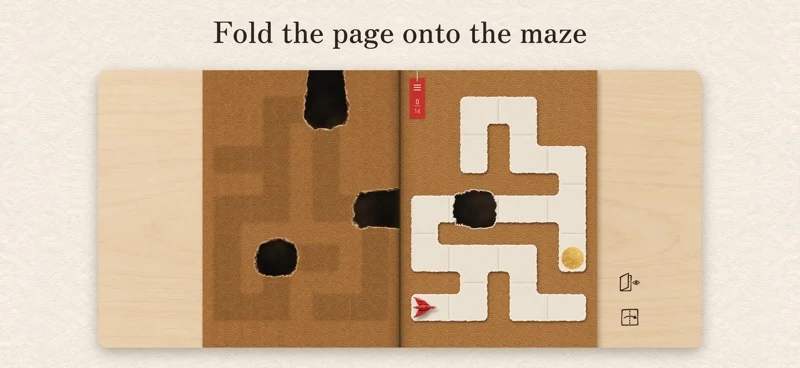 Open full image The open arrangement
The two pages make the changing relationship between surfaces visible.
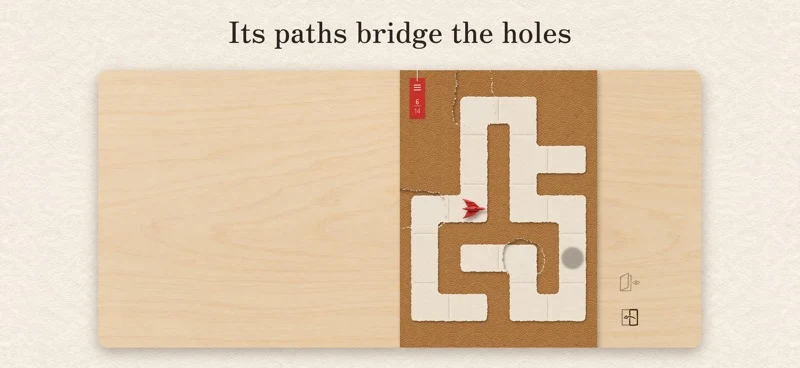 Open full image The folded arrangement
The overlapping page changes the route. These are publisher-selected views, not a recording of one uninterrupted move.
Our design reading: the action matters because it changes what a player can do next. A useful prototype question follows: can someone predict a consequence, try the move and revise their plan?
Separate the rule from the input.
The developer’s description specifies physical folding on iPhone Duo and tap or pinch controls on other iPhones and iPad. Those are advertised controls; we have not tested them.
For your own iOS prototype, write the game rule without naming the gesture first. Then ask how each supported device can express that rule. An unusual input can make a concept memorable, but it also creates a second question: is the underlying decision still interesting with an ordinary control?
A fallback should preserve the choice and its consequences. It need not reproduce the physical sensation. Test comprehension and comfort separately, including whether a player can undo a mistaken action. These are proposed design checks, not findings about Orisuji.
Prototype one consequence before a whole game.
Here is a hypothetical exercise for a small iOS team. Pick a familiar action and pair it with a rule change. For example: rotating a room changes which wall acts as the floor. Build one room with a starting point, an obstacle and an exit. Use plain shapes and a button before investing in a special gesture or a finished art style.
Give an unfamiliar player a goal, then watch without explaining the solution. Record where their prediction differs from the result. After the first successful attempt, change the obstacle while keeping the rule. Can they use what they learned to solve the new arrangement?
- They cannot predict the result: simplify the feedback or the rule before adding content.
- They understand it but have no interesting choice: change the obstacle, trade-off or timing of the decision.
- They discover another use for the same action: make a second challenge that explores it.
These observations help decide what to build next. They are qualitative prototype evidence, not a retention benchmark or a forecast of demand.
Let the decision become the pitch.
Once the prototype works, capture a short sequence: the obstacle, the player’s action and the consequence. Ask a new viewer what they think they would do next. If they can describe the decision, you have a candidate for a clear product demonstration. Whether it earns installs still needs its own test.
Keep the same promise in the playable experience and its store imagery. Our App Store creative-assets note shows how real screenshots can make an experience concrete. For broader discovery, use the app-idea guide to connect a promising interaction to people who might want it.
The next investment is a small playable test. A distinctive move can earn attention; repeated worthwhile decisions are what you still need to build and observe.
Sources & further reading
Examples are hypothetical unless explicitly attributed to a real product. Hypothetical examples illustrate the method and do not represent Piiko results or industry benchmarks.